Sunday, January 11, 2009

Railroading- a dirty business.

Yesterday, Saturday January 10th, 2009 saw another great effort by Brendon Hilton and the grading crew. Several more dump truck loads of rock were removed from "The Cut". There is every indication that we may see track laid through it soon. Brendon writes:

"Our work day yesterday was another big step forward on the cut project. A big thank you to the team. Mike, Robert, Tom, Lars, Eric, and Jon spent the day drilling, hammering, and mucking. It was great that the Tolins had mucked out the previous shot, so we were able to get right to work with the air tools. The results were impressive. Sunday morning, Mike, Dad, and I filled about 20 holes with Dexpan and it could be the last shot. We might need one more drilling session for clean up, but we're there! The dump truck fits through now, so everything else is just gravy."

Click for a Slideshow from Jan 10th.

Rita and I worked on the Pullman picnic shelter. Some of the siding generously donated by Eric Bauer was put up on the north side. More will go up next month.

In the meantime, please enjoy this account of life on the railroad in Ridgway, Colorado back in the day, taken from the Ouray News of January 7th, 2009. This account features the historic facility we are emulating for our Joshua Tree Grand Scale Railway, being built under the direction of our own Ken Eells. - Chris

Coal-darkened tickets tell dark side of railroading

They are more than 85 years old, but when you sort through them your fingertips turn black.

Some are coal tickets with lingering coal dust that were filled out by engineers on the Rio Grande Southern Railroad after having their tenders filled with coal. Others are dark lubricant-smeared oil tickets from the Ridgway trainyard.

Archived at the Ridgway Railroad Museum are Ridgway, Vance Junction, Rico and Ute Junction coal tickets from March 1920 and oil tickets from October 1916.They are part of the materials rescued by Bob Richardson, founder of the Colorado Railroad Museum and saved by Ridgway resident Smiles Dunn until the Ridgway Railroad Museum was established.

Coal was mined near Ute Junction. It was loaded into gondolas (cars open at the top) and transported by rail to loading facilities. At Vance Junction the coal was transferred to coal chutes, but at Ridgway the gondolas were stored until the coal was used.

The Ridgway roundhouse, where repairs and mechanical work were done, was located to the south of what is now Mountain Market, approximately where the hardware store sits. The coaling area was slightly beyond that, just east of the present Drakes Restaurant.

Even something as simple as a coal ticket has a story. Experienced and long-time RGS engineers signed-off on the coal tickets at Ridgway – names like Ervin, McDonald, Talbert, Phillips and Davies. According to Josie Crum in her book, "The Rio Grande Southern Railroad," Ervin and Talbert had been part of a three-engine pile-up in 1909. Davies had ended up in the bottom of a gorge by the Butterfly Mill under bridge debris after an engine derailed in 1910.

Engines leaving Ridgway needed to have full tenders to make the long climb over Dallas Divide and on to Vance Junction or Rico. The tickets showed that loaded coal ranged from one to five tons with most tenders taking on three tons.

In Ridgway, a gondola loaded with coal was placed on a raised track. The engine and tender were pulled parallel to the gondola on a slightly lower track. Coal needed to be shoveled up over the sides of the gondolas and into waiting tenders.

"Coal heavers" not only suffered from aching backs, but clenched fingers as well. Old timers told stories of fingers that cramped around the handles of shovels after hours of labor. At the end of the day, the fingers remained clenched and had to be pried open. Heavers were at the bottom of the pay scale were paid, in 1917, only 10 cents per ton of coal shoveled!

There were many jobs on the railroad that required manual labor, but in my view this was the hardest, with the worst rate of pay. Yet, tons of coal were shoveled daily to provide the energy for the RGS steam engines.

Vance Junction was a major coal loading facility. Handling large amounts of tonnage created a paper problem. RGS Employees frequently ran out of coal tickets. Oil tickets were substituted with the word "oil" crossed out and the word "coal" penciled in. The gravity-fed coal chutes, seven miles southwest of Telluride, can still be seen today.

A. Nordeen signed each oil ticket at the Ridgway shop. The tickets show which engine was serviced and its destination. Generally, 1-1/4 to 1-3/4 pints of valve oil and 2-1/2 to 2-3/4 pints of car oil were required.

Occasionally, cotton waste was also requested. Some oil tickets were for replacement of shop supplies as was the case on Oct. 3, 1916, when 16 pints of headlight oil was ordered. The coal and oil tickets also speak to the economic state of the Rio Grande Southern Railroad. Each one is imprinted with the words "Denver and Rio Grande Railroad." By 1916, the RGS was in receivership and under control of the D&RG. RGS forms were frequently "borrowed" from the larger railroad.

The archived tickets may be gritty and smeared, but they provide an interesting look at the heart of the Rio Grande Southern – and its day-to-day operation.


Monday, December 15, 2008

Rocks rocks and more rocks...

Here is a slideshow of the latest progress on the rock cut excavation, sent in by our Grading Foreman, Brendon Hilton. Brendon and his crew have shown determination and grit in their ongoing quest to get track through the cut. Nice work guys! -Chris


The Rio Grande Southern Railroad: Joshua Tree Style, Part 1

Here is a thumbnail history lesson from now frequent guest blogger, Ken Eells. Who knows? You might learn something! - Chris

It was 1889 when Otto Mears decided that a railroad through western Colorado would be a viable venture, as there were growing mining, timber and livestock interests that the right railroad could service. Mears proceeded to incorporate the Rio Grande Southern Railroad and two railroading legends were born.

Known as the “Pathfinder of the San Juans”, Otto Mears already owned other railroading and mining interests. Not only had he built and operated wagon toll roads in the San Juan Mountains, he was the primary owner of the Silverton Railroad as well as owner of numerous mining operations. With the advent of the Rio Grande Southern Railroad, Otto Mears would create an instant western railroading icon he would coin; Silver San Juan, Scenic Line.

The plan was very simple as the RGS would begin in the yet to be incorporated town of Ridgway, Co. and head south to Durango, 162 miles away. Executing his plan however, was not so very simple as the surveyed right of way began at an elevation of 7002’ rose to that of 10250’and back down to 6523’. The grade for the railroad varied from just under 2% to that of a whopping 4%. Snow drifts at the higher elevations were measured in the tens of feet.

As a three foot gauge railroad, the RGS would be able to seamlessly connect with the Denver and Rio Grande’s Ouray branch at Ridgway and again in Durango to the south. The railroad would have two districts with the first operating from Ridgway to Rico for a distance of 66.2 miles and the second district operating from Rico to Durango for a distance of 95.9 miles.

By March of 1890, 5.5 miles of track had been laid from Durango west to the Porter Coal Mine and the RGS was born. In just two short years of its inception, the 162 mile line was complete and immediately profitable. Then in 1893, the Sherman Silver Purchase Act of 1890 was repealed by Congress and the mines that Otto Mears had built his railroad to began closing, one after another. The whole San Juan region began to die economically and Mears lost control of his young brainchild forever.

The RGS continued on under new leadership well into the 20th Century. With hiccups, bumps and even successes along the way the RGS served the San Juan region for several decades. By 1930, revenue was down and operating costs were high. In 1931, the RGS began constructing a series of internal combustion powered conveyances that would allow for the reduction of normal steam operations thereby cutting operating costs, but maintain revenue business.

Initially known as Motors and eventually Buses by the management, these unlikely looking and operating mechanical concoctions began plying the rail delivering Passengers, Mail and light freight up and down the line. Seven different units were constructed in all and allowed the little railroad to remain in operation. Who originally coined these Narrow Gauge legends as Galloping Geese is somewhat vague, however if the webbed shoe fits . . .

The RGS had another unique distinction, although a bit more sobering. Without many learning of it, until long after World War II had ended, this little railroad had been employed to haul a secret cargo by our government. Previously mined and discarded in mine tailing dumps, seemingly insignificant ore was being loaded into boxcars by miners wearing three piece suits. As it turns out, these materials were subsequently used in developing the first atomic bomb.

The RGS operated until August of 1952 at which point this storied little rail line would cease to exist. But now, a portion of this celebrated railroad is being constructed in 5” scale at the JTSRR Museum as the Ridgway Engine facility of the Rio Grande Southern Railroad.

Journey back in time with us to an era of Big Bands, Coal Soot and War Bonds as we present the RGS, Joshua Tree Style. -Ken Eells

Some historic photos of the RGS in Ridgway, CO.

Thursday, December 11, 2008

Ken's musings.

Here are a couple of items sent in by guest blogger Ken Eells, our jovial roundhouse foreman. Enjoy! - Chris

Railroad Scenery of the Ages

What theme park magnates Walt Disney and Walter Knott had to go through to recreate naturalistic scenic settings for their park railroad attractions was nothing short of magnificent. However, for those of us constructing the JT&S Grand Scale Railway, we could never afford the astronomical costs associated with that level of scenic theming for the railroad. Instead, we have relied on Mother Nature to provide for our Grand Scale Railway: Her very “Grand Scale” scenery.
Born 100 million years ago as a molten liquid that made its way up to the earth’s surface and cooled into massive blocks of a granitic rock called Mozogranite, reshaped and reconstituted many times over with heat, pressure, wind and water has yielded a most amazing desert landscape with which to develop our rail line through.
While some may curse the extreme terrain that we must tackle, we both celebrate and relish the challenges that this unique desert landscape will impart. Once the first leg is graded and rail is laid up to the waterfall in the dry wash, then the dramatic Mojave Desert vistas and unique geology as experienced from the trains will be nothing short of Grand Scale.
-Ken Eells

The Grand Scale Turntable

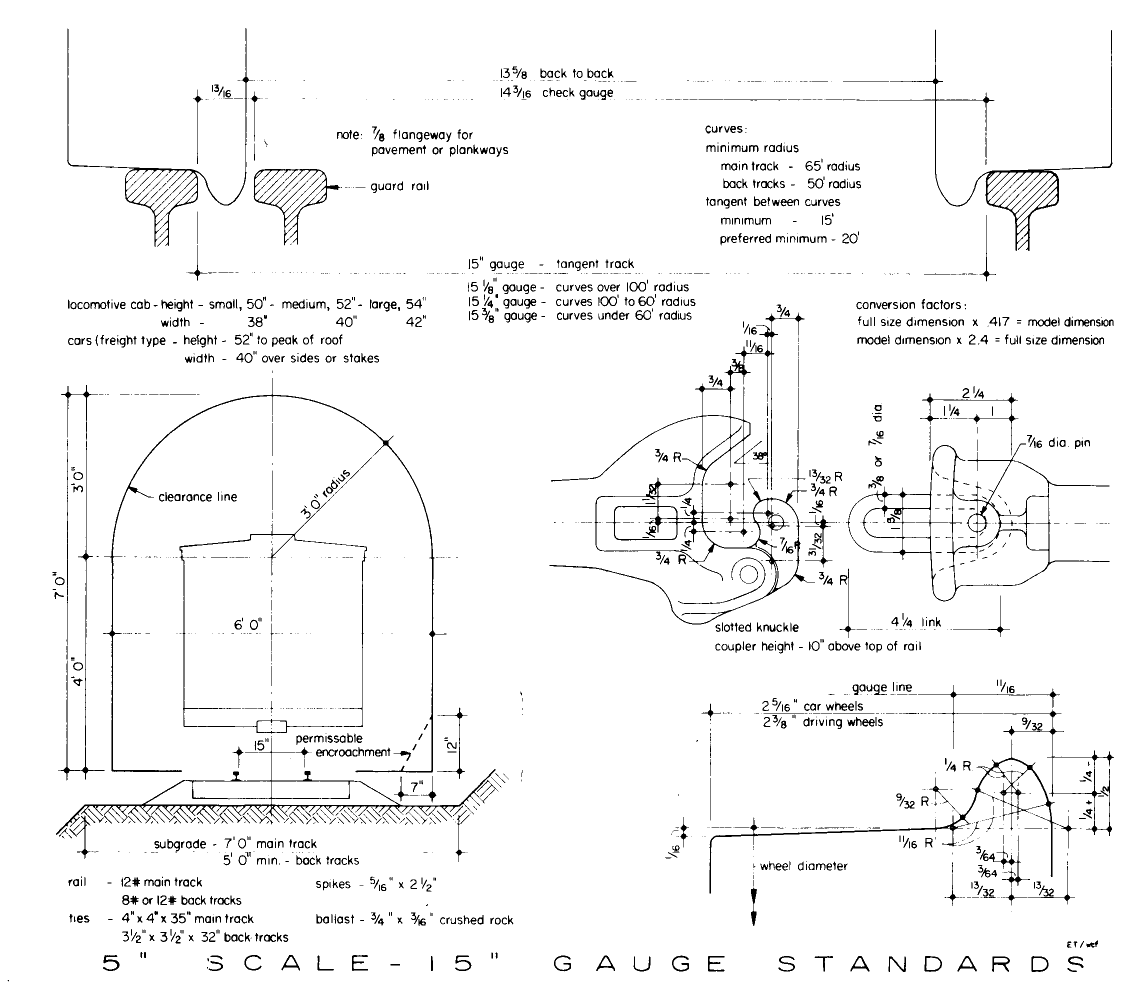
Exciting news: those visiting our museum have turned the 15” gauge Grand Scale turntable into a real conversation piece. All sorts of questions are being asked regarding its design, construction and ultimate operation. So let’s take a brief look and answer some of those questions.
Our turntable is a very closely scaled representation of the one that was used in Ridgway Colorado on the Rio Grande Southern’s three foot gauge railroad. The original was built about 1900 and operated well into the 1950’s. The prototype 50 foot long bridge was constructed of riveted iron girders set in a stone pit. It serviced the seven stall brick roundhouse and operated with one inbound and one outbound track.
In 5” scale, our welded steel bridge is 20’-10” long which is very sizable in its own right. Just like its big brother, the bridge floats on a center thrust bearing. On either end are two iron caster wheel assemblies that engage the top of the ring rail only when a piece of railroad equipment is rolled onto or off of the turntable. When a locomotive is perfectly balanced on the bridge, the center thrust bearing takes the complete load, leaving the wheels to ride about ¼” above the top of the ring rail.
In this configuration the locomotive can be easily turned by one person. This is exactly how the prototype operated, though you could expect to see as many as four men turning the heaviest locomotives. That is how these Victorian era pieces of railroad equipment earned the endearing term of “Armstrong” turntables.
-Ken Eells

Ken Eells in an bemused state.
Ken Eells in an contemplative state.

Saturday, December 6, 2008

Rocks - Friend or Foe?

Rocks seem to be a major- if not the major theme of our 15" gauge railway. What makes our Joshua Tree property special to me personally is the unique topography, the rock formations, and the visual chaos that gives way to a certain grace after you spend some time examining the landscape.

These stony features are also a barrier to the manifest destiny of our little rail line, as evidenced by the Herculean task being undertaken by Grading Foreman Brendon Hilton and his grading crew. The cut being hewn through the seemingly solid rock continues to be worked. The vein of granite at the very bottom of the excavation has proven to be especially problematic:


Photobucket
Bill Shepherd and Brendon Hilton on the rocks. - Rick Mugele

Now to consider the aesthetic. Rocks can benefit our efforts as well. In recent weeks Roundhouse Foreman Ken Eells has been laboriously placing a veneer of rocks over the turntable pit walls, obscuring the cinder block so expertly laid by Bill Shepherd earlier this year. The result is quite pleasing and helps to blend our efforts into the surroundings. The grading crew's efforts have helped Ken as well, producing an endless supply of muck rocks that can be selected for inclusion in the wall:

Photobucket

Turntable wall and ring rail. - Ken Eells

Thanks again to everyone who has given their time to these projects. No small amount of effort goes into them, and it is appreciated. Our collective vision will be realized one day, and no doubt, love them or hate them, rocks will continue to play a big part in our visions, and our nightmares.

- Chris Allan

Photobucket

Rock Drill at Rest. - Ken Eells


Wednesday, December 3, 2008

Welcome to the Blog!

Hello everyone and welcome to the new JT&S Grand Scale Railway Blog. This blog will provide progress updates on the goings-on at our 15" gauge railway, and will eventually replace the old web page, which is at best, cumbersome.

All of the links and features on the old page will be here as well in time, so please be patient, stuff takes time.

Thanks again to all of you who have supported our team effort in the past, and thanks for all of your future support. We wouldn't be able to do it without you.

Check back soon for updates, and have a wonderful Christmas and a prosperous 2009!

-Chris Allan